
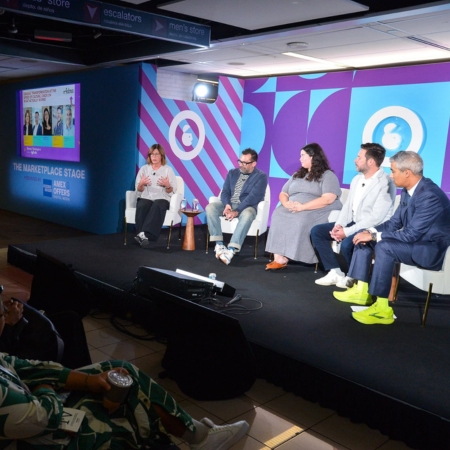
Advertising Week New York Session Recap: Brooks, Alaska Airlines, goop & GM marketing executives share their frameworks for moving fast when stakes are high and resources are limited.
“Our resources have not scaled at the same rate of our ambitions.”
That's how Melanie Allen, CMO at Brooks Running, described a challenge every marketing leader recognizes instantly.
Suddenly you're competing against unanticipated competitors. Navigating historic mergers. Expanding into new categories. Responding to trends in real-time. Redefining your product offering from top-to-bottom.
And somehow, you're expected to do it all with the same team and budget you had when your mandate was half the size.
So how are the most effective enterprise CMOs managing to pull it off?
That was the focus of our recent panel at Advertising Week New York, "Leading Transformation at the Speed of Culture."
In the session, we brought together four seasoned marketing executives to share what’s working for them today (and what isn’t):
We skipped the theoretical and focused on the specific decisions, frameworks, and trade-offs these leaders are making right now to move faster while keeping their teams, brands, and customers at the center of their transformation efforts.
So, when so many marketing fundamentals seem to no longer hold true, how do you know what works?
Start here.
Every enterprise marketer is drowning in the same problem: too many tools, too many vendors, too many "revolutionary" AI solutions promising to transform your business.
Alexa Ritacco, CMO at goop, gets pitched constantly. So does Gwyneth Paltrow, their CEO. And so does the rest of their executive team. "Everyone's constantly, 'Oh, this cool marketing tool,' or 'I met this person at a conference,'" she said.
Her usual response? "We don't have that problem, so we don't need this."
Is this actually a problem for us? That's the first question. Answering it cuts through more noise than any formal vendor evaluation process.
Once you've determined the answer is yes, drill down into what needs to be true for that solution to become a priority.
Alexa's team at goop looks at every initiative through three lenses:
The brand lens: Does this fit how we want to show up in the world?
The business case lens: Does this impact revenue?
The founder lens: Is this a priority for Gwyneth? Does she believe in it?
"Usually, if something is checking two out of three of those, we're pushing it forward as priority," Alexa explained.
That's how you maintain velocity when you're running multiple business lines that all need marketing support. The framework removes emotion from decision-making. It creates space for healthy tension, where brand priorities might not align perfectly with short-term revenue goals. The discipline is in the explicit evaluation, not in forcing false alignment.
Deciding what to start is hard. Deciding what to stop can be so much harder.
Melanie Allen, CMO at Brooks Running, introduced her team to a Gartner framework called "zombies”: initiatives that are still funded, still consuming resources, but not delivering results.
"We're just going through the motions with it," Melanie said. "And just encouraging all of the organization within our marketing team to say, 'You know what, this might be a zombie.'"
The beauty of the framework is that it takes the emotion out of a conversation that's usually very emotional. Nobody wants to admit their project failed.
"A zombie doesn't mean you necessarily kill it," Melanie explained. "It's the discussion around, what would it take to make this no longer a zombie and make it a winner? Or should we look at killing it and moving on?"
Two paths forward: fix it or reallocate. Both are valid. The goal is getting honest about what deserves continued investment versus what's pulling resources from higher-impact work.
Jon Francis, who's led data, analytics, and digital transformation at companies like Nike, Starbucks, GM, and State Farm, puts it simply: "Being really disciplined about clarity of what it is you're trying to achieve and what the measurement needs to be, and having a measure of success."
That discipline makes the hard decisions easier. "You can take all the emotion out of it," he explained. No more protecting someone's pet project because they got promoted for it three years ago.
"You want to be able to move on. Figure out how to streamline it, operationalize it in a way that's light touch, so that you can then go on to the next thing and focus on that."
That's the cultural shift these frameworks enable: permission to move forward faster instead of defending the past.
Once you've decided what to prioritize, you need guardrails for execution. Without them, speed becomes recklessness. With them, you can move fast without breaking what makes your brand valuable.
Eric Edge, VP of Brand and Marketing at Alaska Airlines, grounds his team's AI adoption in two non-negotiable principles:
"We're not going to have AI go in and create a beautiful beach image in San Diego with an experience that is inauthentic to San Diego," Eric explained. "We want to make sure that we have the right core and the right base so that everyone can get behind that."
Those principles create boundaries. Within those boundaries, there's room for experimentation: "I would love 50, 100, 200 scenarios of things happening on that beach in San Diego. I'm agnostic as to what those are, as long as they fit those principles. But that beach has to be the beach in San Diego."
When your team knows the boundaries, they don't need to ask permission at every step. They can experiment, iterate, and learn within a framework that protects what matters most.
Brooks Running learned something surprising in their first few months testing AI-generated product creative.
Runners like to see both shoes. And they didn't care about whether or not an ankle was present.
"A lot of times we would just show one shoe, like one person in action," Melanie said. "But we learned, they don't necessarily need to see the ankle in the shoe. They just need to see the shoe."
It seemed obvious in hindsight. When you're a runner evaluating whether to click, you want to see the thing you're considering buying. The ankle doesn't add information. The single shoe doesn't let you fully visualize the product.
But Brooks didn't know that before. They couldn't know it, because they didn't have the volume of creative variations to test it properly.
"What we had is one shoe. We took one photograph of one shoe, one color way, and all of you had to love it," Melanie explained.
That's the traditional model. Creative team shoots the product. You get one hero shot per colorway if you're lucky. Maybe a few angles. You put your best foot forward (sometimes literally) and hope it resonates.
"Now I can show all of our color ways in multiple ways and with different headlines, different text, etc."
The learning compounds. You're not just learning "runners like to see both shoes." You're learning which colorways resonate in which markets. Which angles drive better clickthrough. Which contexts make the product more appealing.
"We're learning so much already within the first few months."
That velocity creates a compounding advantage. Every test informs the next test. Every insight suggests three more hypotheses worth testing. The gap between you and competitors who are still waiting weeks for creative production starts to widen.
"What this is allowing us to do is go bigger, up funnel. We're moving into new categories. So there's some new lifestyle shoes, some other spaces, apparel."
The performance marketing doesn't stop. It gets faster and more efficient. That efficiency creates capacity to focus on brand-building that used to compete for the same resources.
Eric Edge's world at Alaska Airlines is constantly changing.
"Airlines are very dynamic. They're multifaceted. You never know what you're going to wake up to each day. Travel trends change by the minute. And so you may think one area, one region, is going to be amazing one year, and it's a different region completely."
When a new route launches or an existing route’s popularity spikes, Eric’s team needs creative that speaks to that destination right now, not six weeks from now.
That's not just an airline reality. It's the reality for any consumer brand where trends, culture, and consumer preference move faster than traditional production timelines.
The brands that can test 50 variations instead of 5 learn faster, make better decisions, and compound those advantages over time.
Jon Francis has spent 30 years deploying data scientists to answer business questions. For most of that time, he's watched expensive, specialized talent get consumed by basic questions.
"You've got really well-paid, expensive data scientists working on very low level types of questions," Jon said. "Everyone, especially over the last probably 10 to 15 years, talked a lot about data democratization, but that hadn't really proven itself out."
Until now.
What's changed isn't just speed. It's what that speed makes possible organizationally.
When natural language queries can surface insights that used to require coding skills, you free your data scientists to work on hard problems. Differentiated capabilities. Better targeting. Incrementality analysis. The strategic work that actually creates competitive advantage.
"Now your data scientists should be working on the hardest problems for the organization, where you need that specialized skill set."
The same logic applies to creative teams. When AI handles volume and variation, your creative directors can focus on the brand work that actually requires human judgment and emotional intelligence.
Brooks Running has a collaborative, consensus-driven culture. When Melanie brings an opportunity to the team, usually everybody gets in the boat and starts rowing in the same direction.
But when she brought them the opportunity to pilot Adora's AI-generated advertising creative, she had team members "fully outside the boat." Maybe even throwing a few grenades back in.
Her head of creative, someone who typically goes with the flow, delivered what Melanie described as an "over my dead body" response.
Most organizations would have seen that as a problem to overcome or an immediate initiative killer. Melanie did something different: she leaned into it.
"We just labeled him the skeptic, and we're like, 'You know what? You can be the skeptic in the room,'" Melanie said. "And so for the last year, he's been the skeptic, which has been great, and he's been really hard on, I think, the entire team, just to keep making it better for us."
That reframe changed everything. Instead of trying to convince him or work around him, they gave him explicit permission to be skeptical. His job was to make sure anything that went to market met Brooks' standards for quality and brand authenticity.
The result? Better creative. More rigorous evaluation. Stronger confidence in what did make it to market. And ultimately, better performance.
"Just a couple weeks ago, we sat in a room trying to figure out which creative was which, and we were wrong. Many times we mixed up creative team creative and Adora's AI creative. Both of us got it wrong multiple times."
That's the kind of validation you can't get without keeping your skeptics at the table.
Your attribution doesn't add up to 100%.
Meta says it drove 50% of sales. Google says 75%. Your email platform claims 30%. Your new AI creative tool wants credit for improving all of them.
"Well, you didn't sell 170% of product," as our CEO Marco Matos likes to point out. "You only sold 100%."
Every platform has an incentive to claim outsized credit. Every channel owner has an incentive to optimize for channel-specific metrics. Your Google rep isn't going to tell you to reduce spend, even when your incrementality analysis does.
The question isn't whether any individual channel is lying. It's whether you're measuring the right thing to begin with.
Each business will have different priorities in different seasons. Currently, goop's is new customer acquisition. So Alexa Ritacco keeps her team focused on LTV:CAC, total business ROAS, and new customer ROAS.
"I like to keep them anchored to these three. [Because] there are all those channel specific metrics where, if you're a channel owner, of course you want to be looking at, tracking, and evaluating them constantly," she said.
The problem arises when channel blinders work against your overall objectives. "I keep them anchored in those top line business metrics...so no one gets too in the weeds." When a single channel claims it's driving 75% of revenue on its own, something is being lost in translation.
The discipline is keeping everyone oriented toward the same North Star. Your paid social manager should understand how acquisition efficiency rolls up to overall customer economics. Your email team should understand how retention connects to LTV.
"All tides rise together."
That shared orientation changes how teams work together. You're not fighting over attribution credit. You're figuring out how the ecosystem needs to work collectively to hit business goals.
Eric Edge takes a holistic view at Alaska Airlines.
"I want to see collectively, is the entire funnel and the entire ecosystem driving a return on the business. If it is, then we're doing something well."
But that doesn't mean every channel gets measured the same way.
"We just put a new MMM model in place, and we're measuring what brand does to actual revenue. And we're seeing that even in a channel and a place where you don't have a goal of revenue (like brand)...we are driving revenue."
Brand advertising drives revenue. Just not in the same way or on the same timeline as performance marketing.
"There is still a return on that. Is that return the same as it is when we get down into performance? No, but it shouldn't be."
The sophistication is in understanding how different parts of the funnel contribute to the whole. Brand builds awareness and consideration that make performance marketing more efficient. Performance marketing captures the demand that brand created. They work together.
"I want to look at that holistically and just make sure the organization understands that this ecosystem that we've created will drive that return. It doesn't mean that every single channel is going to be this breakthrough, amazing channel on revenue, but collectively, they have to work together to do it."
If you're reading this and thinking "our resources haven't scaled with our ambitions either," you're in good company.
It's a tension most marketing leaders manage these days. The difference between rising to the occasion or falling to the pressure might lie in the frameworks you lean on when navigating uncharted waters.
Whether you're trying to sift through AI noise, scale your marketing operations without losing your brand, or get your creative team and performance team pulling in the same direction, there are plays to borrow and leaders to learn from.
The key is assembling the playbook that works best for your brand.
Watch our full conversation from Advertising Week New York: